Permitting and Act 250

Guidance on permitting, archaeological review, and Vermont Act 250
When embarking on a trail project, it is important to understand what permits you need to apply for or review processes you must complete before you break ground. Please consider the following information on ANR permits, archaeological review, and Vermont’s Act 250 to be general guidance and not the final word.
The single most important thing to remember is that you should always check with your local Act 250 District Coordinator for a jurisdictional ruling before any work begins. District Coordinators have the authority to decide whether a project requires a permit. Each trail project is unique, and there are a number of factors that will influence a District Coordinator’s jurisdictional determination.
Act 250
Critically, Act 250 can cover trail projects in Vermont as part of its jurisdiction over commercial construction on land tracts of a certain size, depending on subdivision and zoning bylaws. Municipal, state and county purpose trails, including trails that are part of the Vermont Trail System, can also trigger Act 250 jurisdiction based on the acreage of impacts Substantial changes to pre-Act 250 trails can also trigger the need for a permit under these rules.
If a trail project is believed to meet any of the Act 250 jurisdictional criteria (described below), the case is first reviewed by a District Coordinator, who issues a jurisdictional opinion (JO) as to whether an Act 250 permit is indeed required. A JO is not required, but is a useful tool if there is a question as to whether Act 250 applies. Either way, the coordinator is the first point of contact for a JO or an application.
Four major factors come into play when evaluating whether or not a trail project is likely to be subject to Act 250: construction of improvements; whether the trail is private or public; the area of the parcel(s) or the area that is physically disturbed; and whether or not there is an existing Act 250 permit on the property.
Act 250 only requires a permit for the construction of improvements, not maintenance. While an important distinction, the difference between the two can be ambiguous and may require direction from the local District Coordinator. For example, the re-routing of a trail in some cases can be considered “maintenance.” The balance of this document assumes that a trail project has been determined to be construction rather than maintenance.
All trail projects in Vermont are considered either “private” or “public.” On public lands, Act 250 jurisdiction is triggered when the construction of the trail and its related infrastructure (such as parking lots) will physically disturb more than ten acres. This is the rough equivalent of 20+ miles of handbuilt trail or 10+ miles of machine-built trail.
For trails on private land, Act 250 states that a permit may be required if the project is on a tract or tracts of land over ten acres in size, or if it “involves” a tract or tracts of land which, when combined, are over ten acres in a town with municipal zoning and subdivision regulations. If the town lacks such regulations, the threshold area that triggers Act 250 is just one acre. The default for private land is that the length of the trail is not a factor in determining Act 250 jurisdiction; it is the size of the land on which the trail will run that controls the question of jurisdiction. If, however, the trail is designated as part of the Vermont Trail System, the project is considered “public” and the jurisdictional trigger becomes the same as for a trail on public land: more than 10 acres must be physically disturbed. This is very good news for avoiding Act 250 permitting on private land.
The Vermont Trails System (VTS), established by statute, is made up of trail networks designated by the Secretary of Natural Resources upon recommendation by the Vermont Trails and Greenways Council. The VTS designation acknowledges these trails as public assets, and they are therefore treated as public projects, meaning that more than 10 acres must be physically disturbed before triggering Act 250, as noted above. To be considered part of the VTS, there must be a signed agreement with the landowner in advance of construction. A shape file of the completed trail must also be submitted, which is retained by the State of Vermont and can be made available upon request. VTS designation does not, however, require landowners to provide maps, either physical or digital, of their trails.
If there has been a previous Act 250 permit issued for a project on the land where a trail is proposed, an amendment to that permit may be required for any projects on that land. This is because Act 250 has “continuing jurisdiction” over land once a permit has been issued. To acquire an amendment, trail organizations, trail builders, or landowners should contact their District Coordinator.
As a general rule, where proposed trails pass through both state and private lands, Act 250 jurisdiction on the state land is triggered if there are more than 10 acres of disturbance (see above), and Act 250 jurisdiction is triggered on the private land if the parcel meets the acreage (one or ten acres) threshold. Trails passing through municipal and private land are treated as private projects unless the project is designated part of the VTS as described above.
Permitting
Trail projects may require permits before construction begins, whether or not you own the land or are only working within the existing footprint. The first step is to put the project through the Permit Navigator tool found on the Department of Environmental Conservation website. This tool will help you determine which permits may be needed before construction begins.
Wetland program Permits
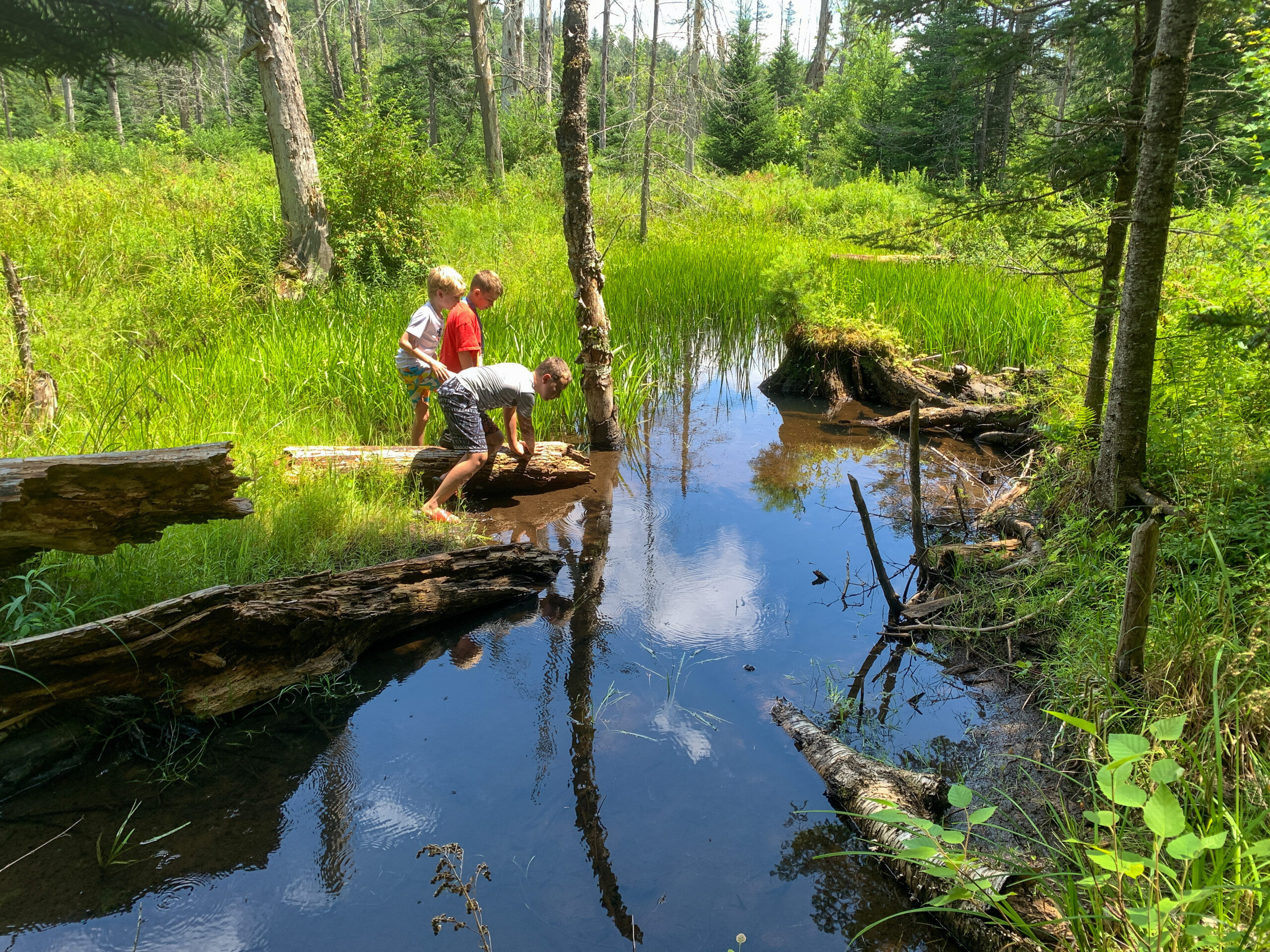
The alteration of the physical and vegetative characteristics of wetlands and their buffer zones (areas within 50 feet of the wetland boundary) to install trails typically triggers wetland jurisdiction. Please study the Forest, Parks, and Recreation wetlands program guidance carefully to evaluate whether you will need a permit.
Archaeological Review
Regardless of whether your trail project requires an archaeological review, it is important to respect those who came before us: avoid disturbing rock walls or using their stones for trail construction, and do not disturb old home sites.
All federal project funds, including the Recreation Trails Program (RTP) and Land and Water Conservation Fund (LCWF), and state projects that trigger Act 250, require an archaeological review. Read about the State Archaeology program review process within the Vermont Division for Historic Preservation.
Still Have Questions?
Can’t find the information you are looking for? Reach out to us.
